Building Audience Data for Industrial Prospecting
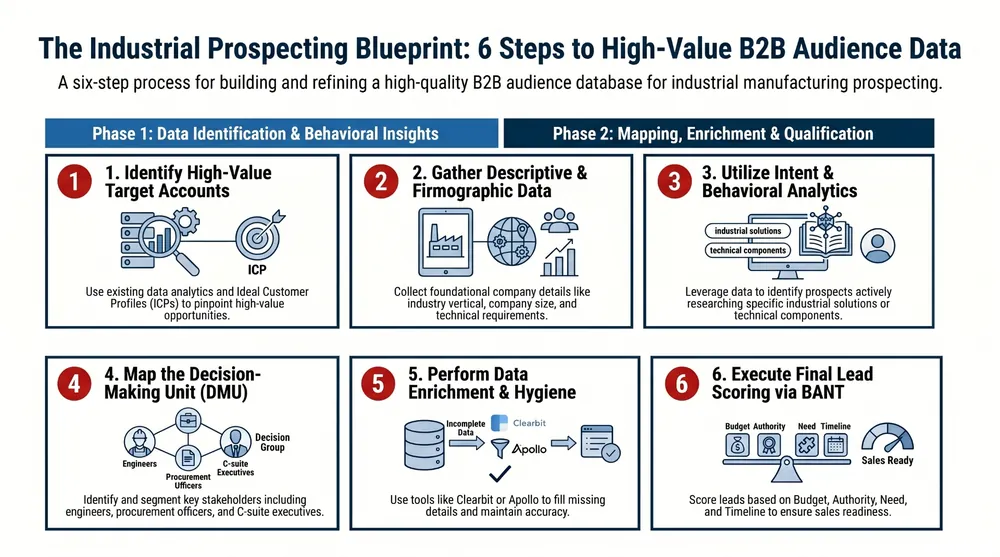
In industrial markets, the difference between a full pipeline and an empty one usually comes down to one thing: who you're targeting.
Not your messaging. Not your budget. Not your channels.
Your audience.
Industrial buyers are specific—engineers, plant managers, procurement teams, operations leaders. If your targeting is off, even the best campaigns fall flat. If it's right, everything else starts to work.
This is how to build audience data that actually drives industrial prospecting and leads to real RFQs.
Why Audience Data Comes First
Most companies jump straight into tactics—running ads, publishing content, sending emails.
But without the right audience, those efforts don't connect.
Strong audience data allows you to:
- Reach decision-makers instead of general traffic
- Align messaging with real needs
- Improve engagement across channels
- Shorten the path from first touch to RFQ
In industrial prospecting, precision matters. You're selling to a defined group with specific requirements and avoiding those who can't impact sales.
Start With Firmographics
The foundation of industrial audience building is firmographic data—details about the companies you want to reach.
This includes:
- Industry, such as aerospace, automotive, or energy
- Company size, including revenue and employee count
- Location and service area
- Production capabilities or needs
For example, a shop specializing in tight-tolerance CNC machining for aerospace parts shouldn't be targeting general manufacturing companies. It should focus on aerospace OEMs and suppliers with those exact requirements.
This level of filtering eliminates wasted effort before campaigns even begin.
Layer in Role-Based Targeting
Once you know the right companies, the next step is identifying the right people.
Industrial buying decisions often involve multiple stakeholders:
- Engineers evaluating technical fit
- Procurement teams managing vendors
- Operations leaders focused on efficiency
Your audience data should reflect this.
Instead of targeting "companies," you're targeting:
- Manufacturing engineers
- Supply chain managers
- Plant managers
- Technical buyers
Each role interacts with content differently. The more precisely you define them, the stronger your outreach becomes.
Use Behavioral Signals to Prioritize
Not all prospects are equal. Some are actively researching. Others aren't ready yet.
Behavioral data helps you identify who's closer to action.
This includes:
- Search behavior, including keywords they're using
- Content engagement, such as what they read or download
- Website activity, including competitors visited, pages visited and time spent
- Ad interactions
When you combine firmographic and role-based data with behavior, you move from broad targeting to prioritized prospecting.
Now you're focused on the accounts most likely to convert.
Build Account-Based Audience Segments
In industrial markets, high-value deals often come from a defined set of target companies.
That's where account-based targeting comes in.
Rather than casting a wide net, you:
- Identify specific companies you want to win
- Build detailed audience profiles for each
- Tailor outreach and content to match
This approach is especially effective for:
- OEM suppliers
- Specialized manufacturers
- Niche industrial services
It creates more relevant engagement—and better conversations.
Prepare Audiences for Each Channel
One of the biggest mistakes in industrial marketing is using the same audience everywhere.
Each channel requires a slightly different structure.
Digital Campaigns
For programmatic, PPC, and paid social:
- Segment audiences by role and industry
- Refine targeting based on behavior
- Exclude irrelevant groups
Content Campaigns
For blog distribution and syndication:
- Match audience segments to specific topics
- Align technical depth with audience expertise
- Distribute where those audiences already engage
Email Campaigns
For outreach and nurturing:
- Build segmented lists
- Personalize messaging by role and need
- Sequence communication based on engagement
Preparing audiences correctly for each channel increases relevance—and results.
Clean and Validate Your Data
Bad data kills performance.
Outdated contacts, incorrect job titles, and incomplete company profiles lead to:
- Wasted ad spend
- Low email engagement
- Missed opportunities
That's why audience data needs to be:
- Verified
- Updated regularly
- Structured for easy use across platforms
Clean data doesn't just improve targeting—it improves everything downstream.
Turn Audience Data Into Real Prospecting
Once your audience is built, the next step is activation.
This is where strategy and execution come together.
Your audience data should power:
- Targeted ad campaigns
- Content distribution strategies
- Email outreach and nurturing
- Retargeting efforts
The goal is to create multiple touchpoints with the same audience across channels.
This builds familiarity—and increases the likelihood of engagement.
The Impact on RFQs
When your audience data is strong, the results are clear:
- Higher-quality traffic
- More relevant engagement
- Better alignment between marketing and sales
- More consistent RFQs
Instead of chasing leads, your marketing starts attracting the right ones.
That's the difference between activity and performance.
Final Thoughts: Precision Wins
Industrial prospecting is most successful when targeting and messaging is precise.
When your audience data is:
- Clearly defined
- Properly segmented
- Continuously refined
…your entire marketing system becomes more effective.
Campaigns perform better. Messaging connects faster. Sales conversations start with context.
And most importantly, RFQs become consistent.
Because in industrial markets, the companies that win aren't the loudest—they're the most precise.